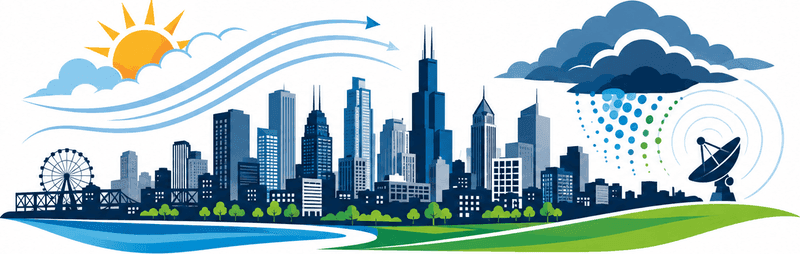
The low atmosphere
Atmospheric boundary layer (ABL)
The layer of the atmosphere most influenced by the Earth's surface and human activity. It extends approximately ~10 m – 2 km above the ground.
Vertical structure
From the surface layer to the free atmosphere
- Free atmosphere~1 km and above
- Weather systems, en route aviation and upper-level dynamics.
- Boundary layer top~500 m – 2 km
- The upper limit of the atmospheric boundary layer.
- Urban Air Mobility operating zone~50 m – 500 m
- Where eVTOLs, drones and air taxis operate, within the boundary layer.
- Surface layerroughly 0 – 50 m
- Directly influenced by buildings, infrastructure and terrain.
What shapes it
Drivers and interactions
The founding concept groups the influences on this layer into meteorological drivers, surface and terrain processes, onshore and offshore interactions, and interactions with human systems.
Meteorological drivers
- Wind shear & turbulence
- Thermals & convection
- Temperature gradients
- Moisture & clouds
- Visibility & precipitation
Surface and terrain processes
- Turbulence & rotor wake
- Sea breeze
- Urban heat island & convection
- Terrain effects & channeling
Onshore / offshore interactions
- Maritime operations
- Offshore wind farms
- Coastal winds & sea breezes
- Coastal convection & weather
Human system interactions
- Public Health
- Energy
- Urban Planning
Across a region
Marine, urban and rural boundary layers
A metropolitan region spans several boundary layers at once. The founding concept sets them side by side, with the interactions between them as the subject of study.
Marine boundary layer
Offshore, over the water
Urban boundary layer
Over the city, including the mixed layer, aerosols and the surface layer
Rural boundary layer
Inland, beyond the urban area
- Onshore / offshore interaction
- Urban / rural interaction
- Human system interaction
Scales
Mesoscale, local scale, microscale
Urban weather is a multi-scale problem. The founding concept reproduces this structure from the published literature.
Mesoscale
- Geostrophic wind
- Heat island circulation
- Urban boundary layer (UBL)
- Urban plume layer (UPL)
- Rural boundary layer (RBL)
- Urban canopy layer (UCL)
Local scale
- Surface layer
- Inertial sublayer
- Rough sublayer
- Artificial heat release
- Urban canopy layer (UCL)
Microscale
- Urban street canyon (USC)
- Rough sublayer
- Urban canopy layer (UCL)
Source: Dai et al., Sustainable Cities and Society (2025).